Product R&D · Acquisition workflow
Keep task-order packages moving in one place.
The TORP Module within RFPing is in development. It is designed to assemble, route, track, and administer Task Order Request Packages (TORPs) under indefinite-delivery, indefinite-quantity (IDIQ) contracts.
RFPing is a pre-launch government-contracting workspace. We’re building its TORP Module to help teams prepare requirements, generate documents, route reviews and approvals, and manage post-award work. The aim is one workflow in place of manual Word/Excel assembly, email chains, and separate status spreadsheets.
Inside the current build
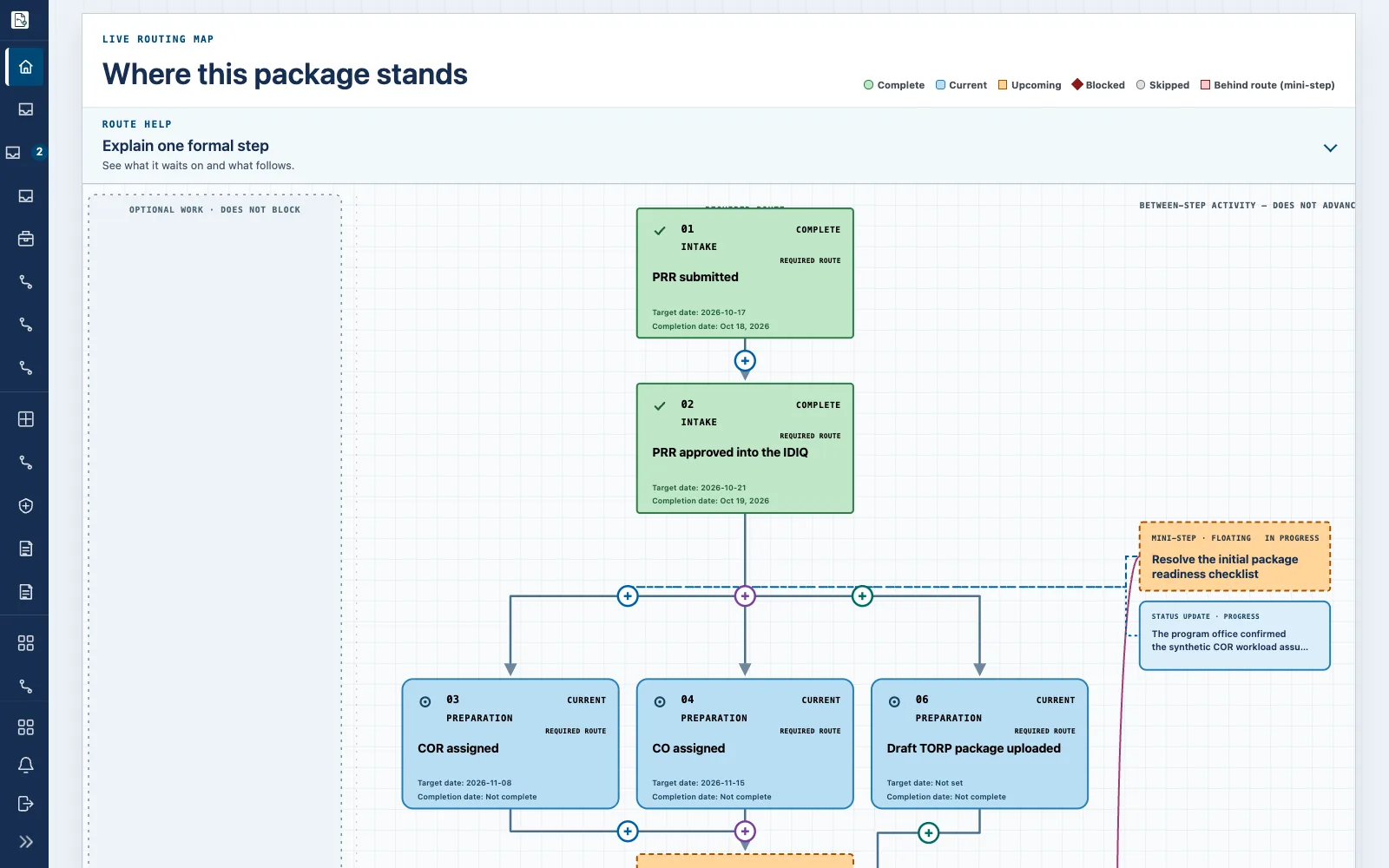
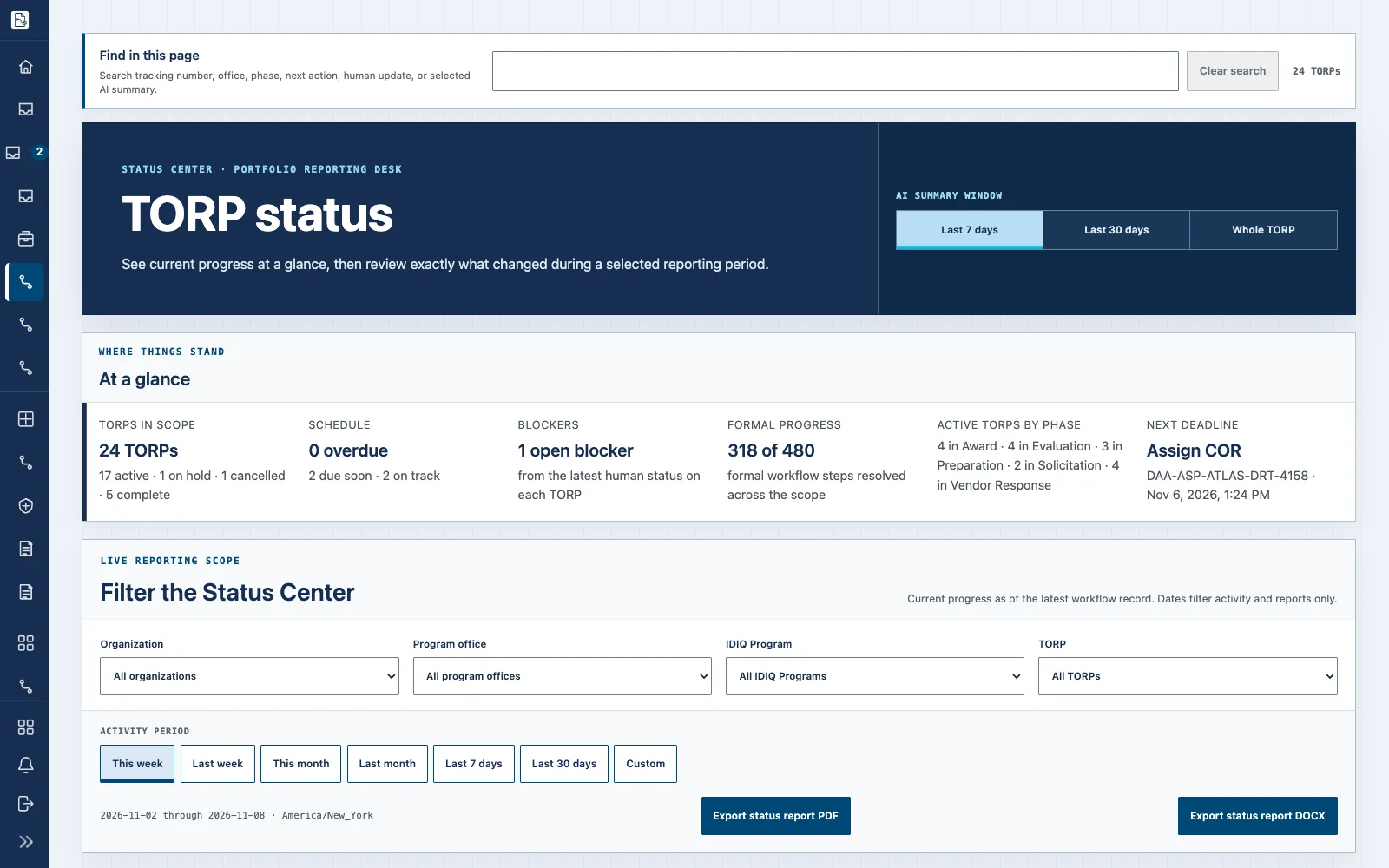
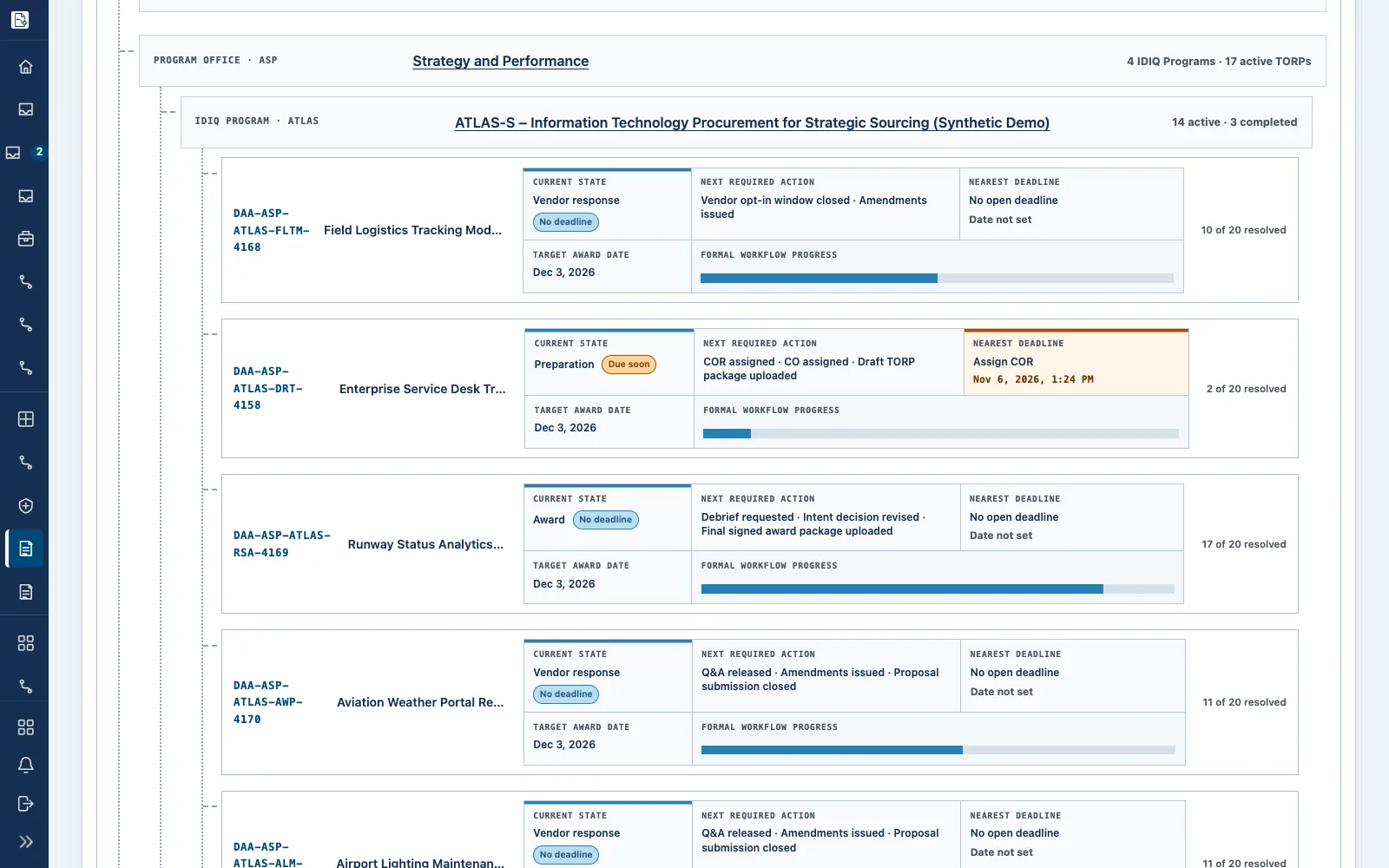
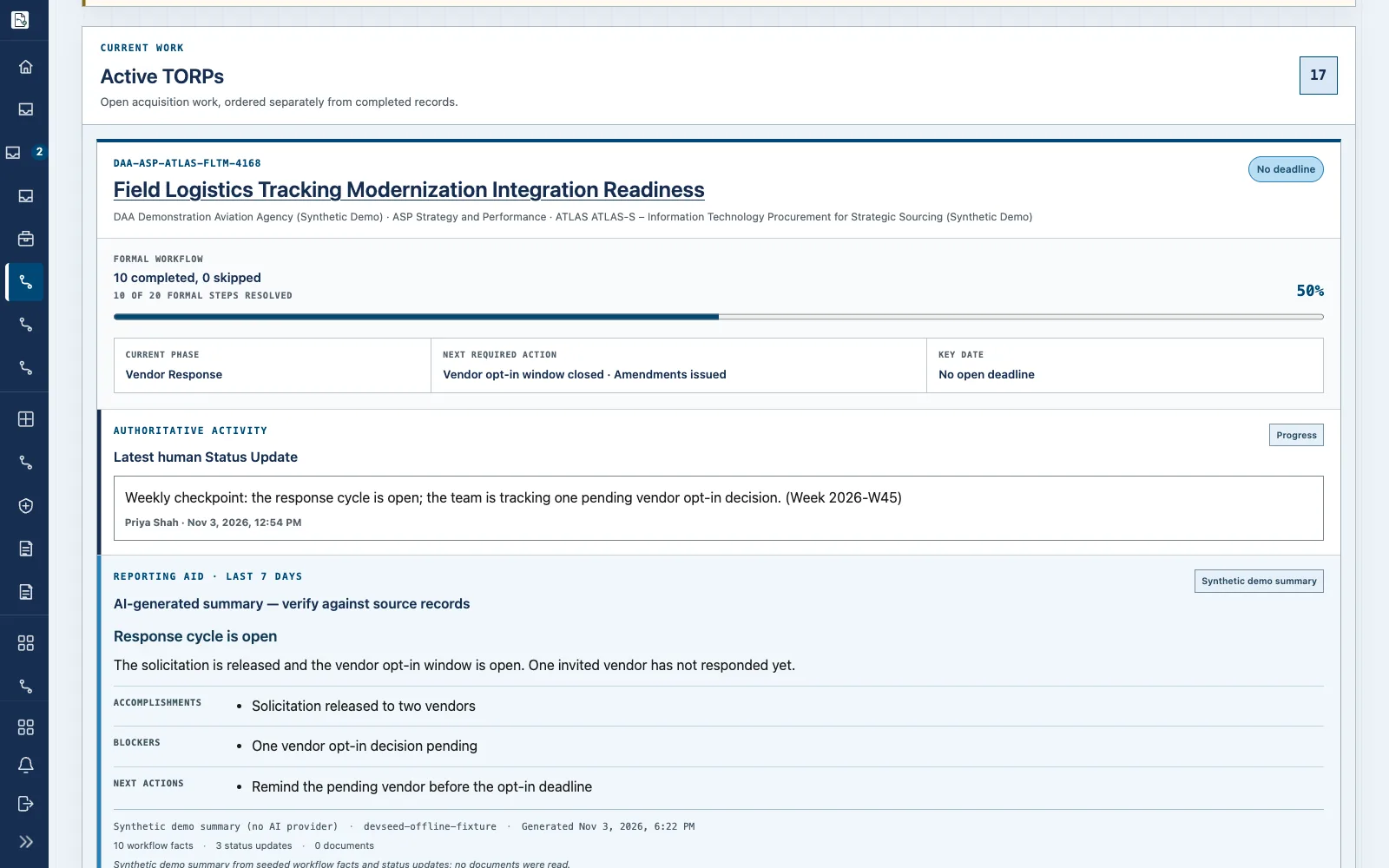
Screens from a local build of RFPing with synthetic demonstration records. The agency, programs, vendors and people are invented.
What needs fixing
Contracting Officer’s Representatives (CORs), technical staff, and acquisition support teams often move between Word documents, Excel sheets, email, and legacy systems. They enter the same data more than once and struggle to see status. The TORP Module is designed to record package cycle time and post-award performance. Each engagement would set and test realistic targets.
What we’re building the TORP Module to do
Package Assembly
Your team would enter data once through web forms to populate related documents. The module would generate documents from the agency's approved .docx, .xlsx, and PDF templates. Acceptance tests would verify that the output matches those templates.
Routing & Approval
Electronic routing would replace email chains with configured review, comment, and approval workflows. The system would record every approval in an audit trail.
Status Dashboard
A single dashboard would show all TORPs and their current stage, replacing separate email searches and spreadsheet updates. The design target is 100+ concurrent packages; an engagement would verify that target with load testing in the customer environment.
Post-Award Management
Teams would configure deliverables or use standard templates for monthly status, financials, staffing, travel, overtime or excess hours, other direct cost approvals, resumes, training, and government-furnished equipment requests. Awardees would submit them directly against agreed due dates. Authorized users would review and authorize invoices. They could track obligations, spending, and remaining balances in one place.
- Word templates filled manually
- Data re-entered across spreadsheets
- Routing via email chains
- Status tracked in a separate spreadsheet
- Some packages take months; measure the actual baseline
- Approved fields populate configured templates
- Electronic routing with audit trail
- Real-time status dashboard
- Awardees submit deliverables directly
- Cycle-time target measured in the engagement
Current design
The current design uses PostgreSQL, a Go service, SolidJS frontend, and Connect RPC API. We would configure deployment, approved dependencies, backup, recovery, and disconnected operation for the customer environment. Section 508 conformance would be verified at acceptance.
The design calls for role-based access for Technical POCs, Acquisition Support, CORs/COTRs, and Contracting Officers. Initial deployment would use OAuth. PIV/CAC authentication is planned for production government networks.
A practical first increment
We would start with one package type and agree on templates, roles, approval routing, security, identity, deployment, and exports. Acceptance tests would check document fidelity, routing, audit history, permissions, cycle time, and Section 508 and accessibility behavior. The handoff would include agency data, generated packages, configuration, training material, and operating documentation.
What we’re working on next
Pending work as of November 2026. Plans can change as we learn.
- In progress
Contract staffing roster
Track filled and vacant positions, and link onboarding steps to each person.
- In progress
Government property tracking
Registration and corrections work today. Inventory audits, transfers and loss reporting come next.
- Planned
Audited record editing
Clear edit actions on records, with a full history of who changed what.
- In progress
Complete interface testing
Exercise every control with a real user-journey test before we call a feature finished.