Working hackathon MVP · Investigation support
Give investigators a prioritized path through public Medicare data.
Indicium, formerly Integrity, is a working hackathon system that helps investigators prioritize providers for review. Its risk signals trace back to source data; they are not fraud findings.
What we’ve demonstrated: Indicium is a company-led ACT-IAC hackathon winner built on public data. The metrics below describe that build and its analytical validation. They do not establish federal production past performance, agency fraud findings, or realized savings.
Inside the current build
Historical screens from Indicium’s hackathon build, then called Integrity, running on its built-in demonstration data. The provider shown is fictional.
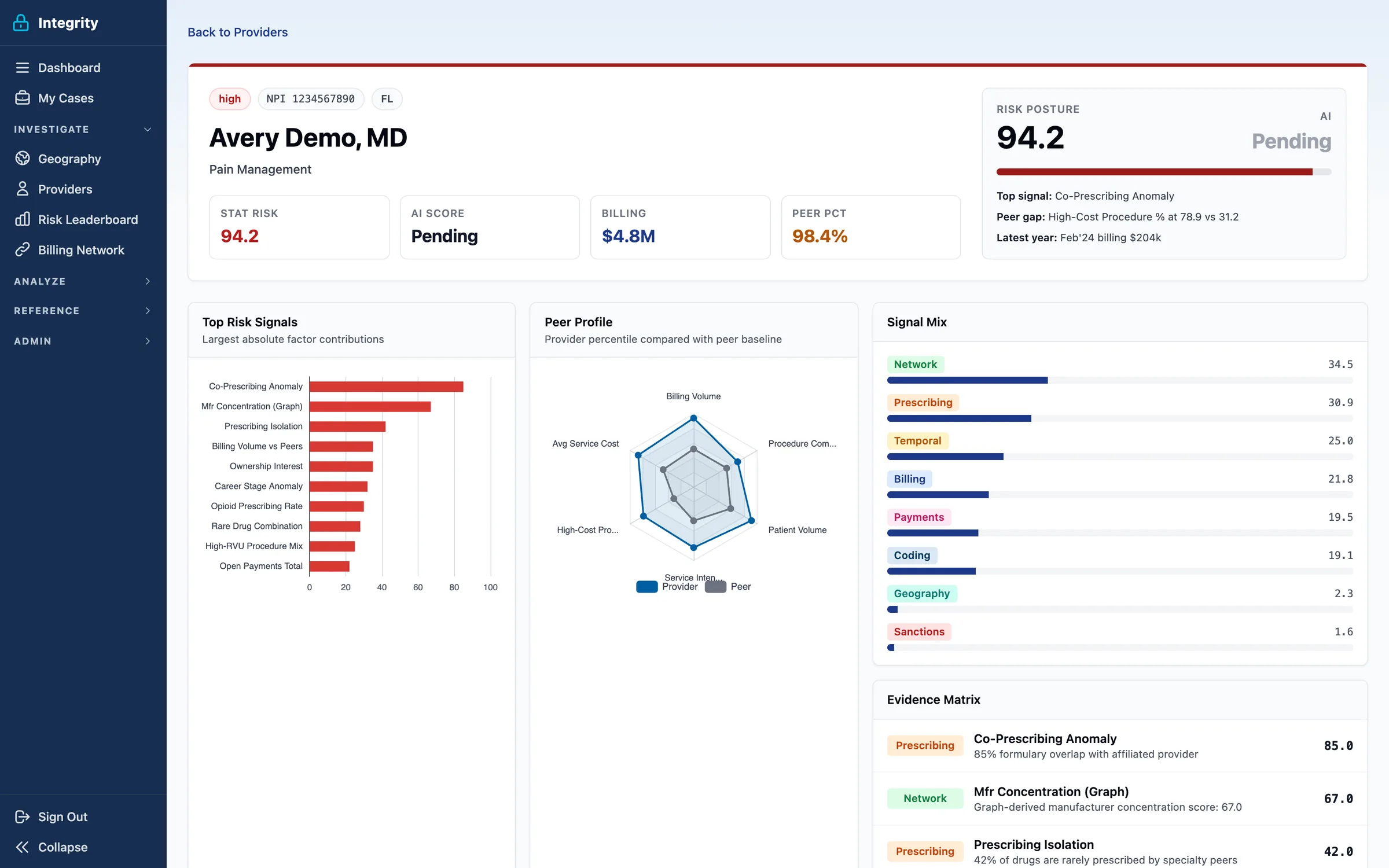
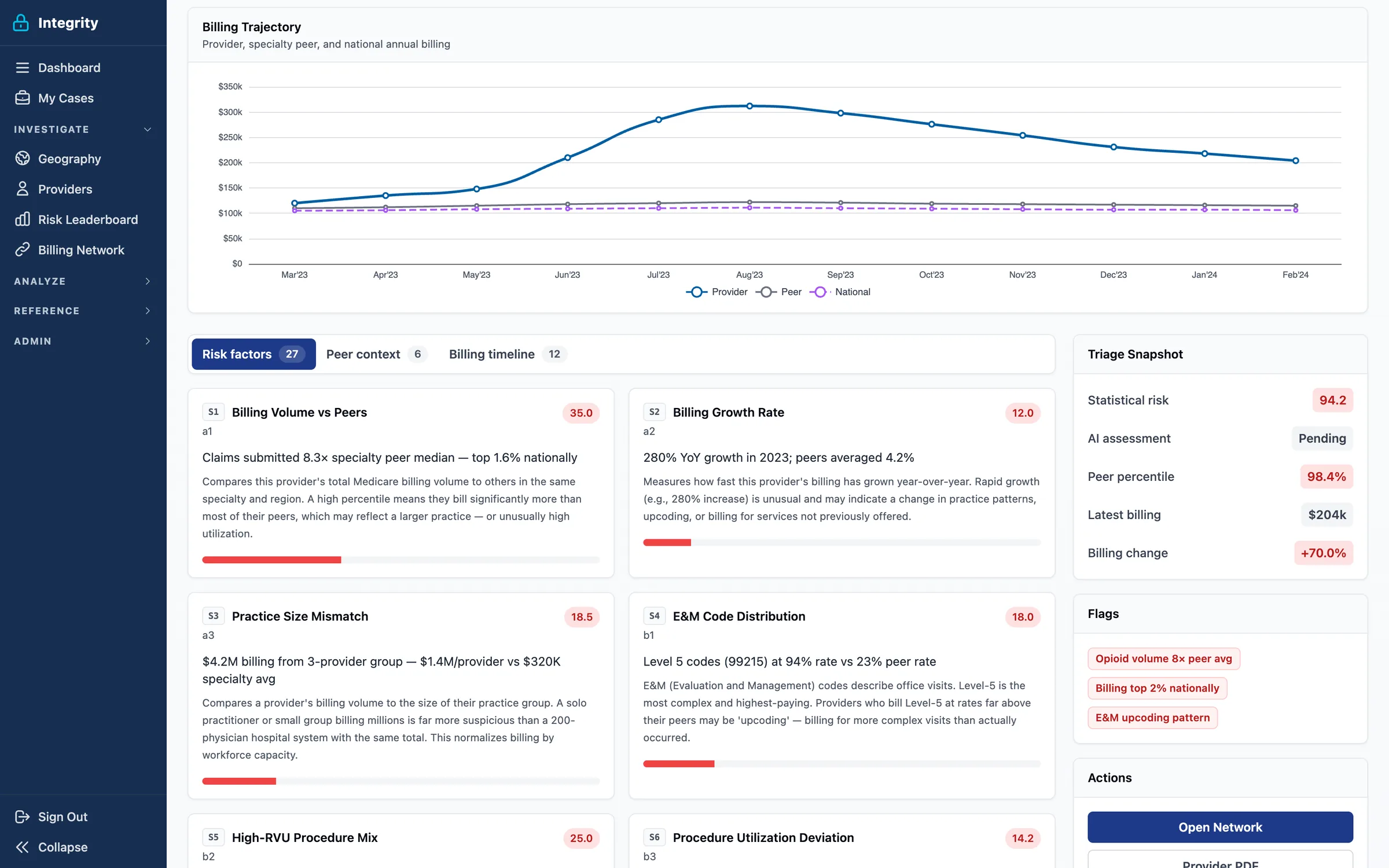
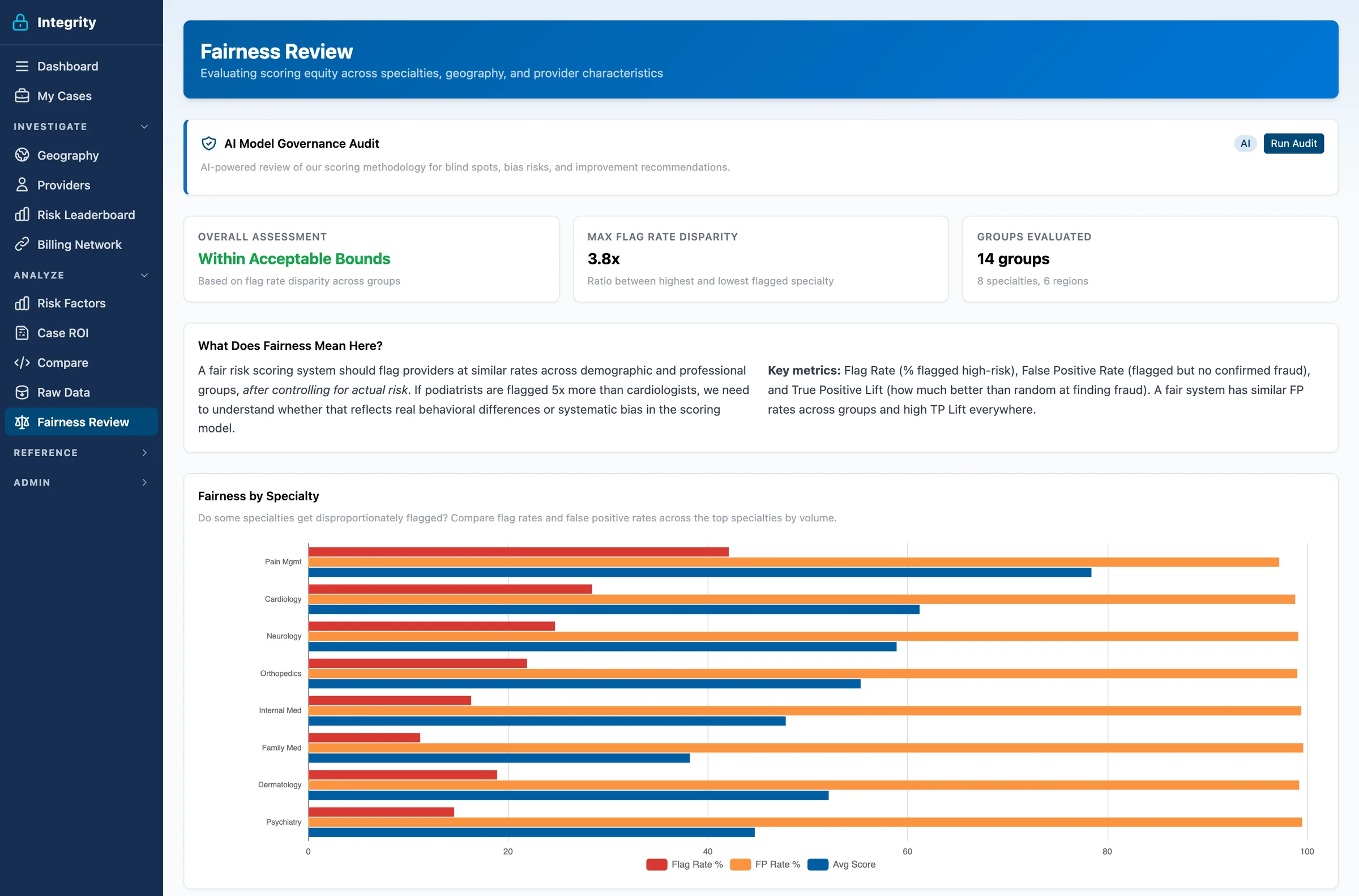
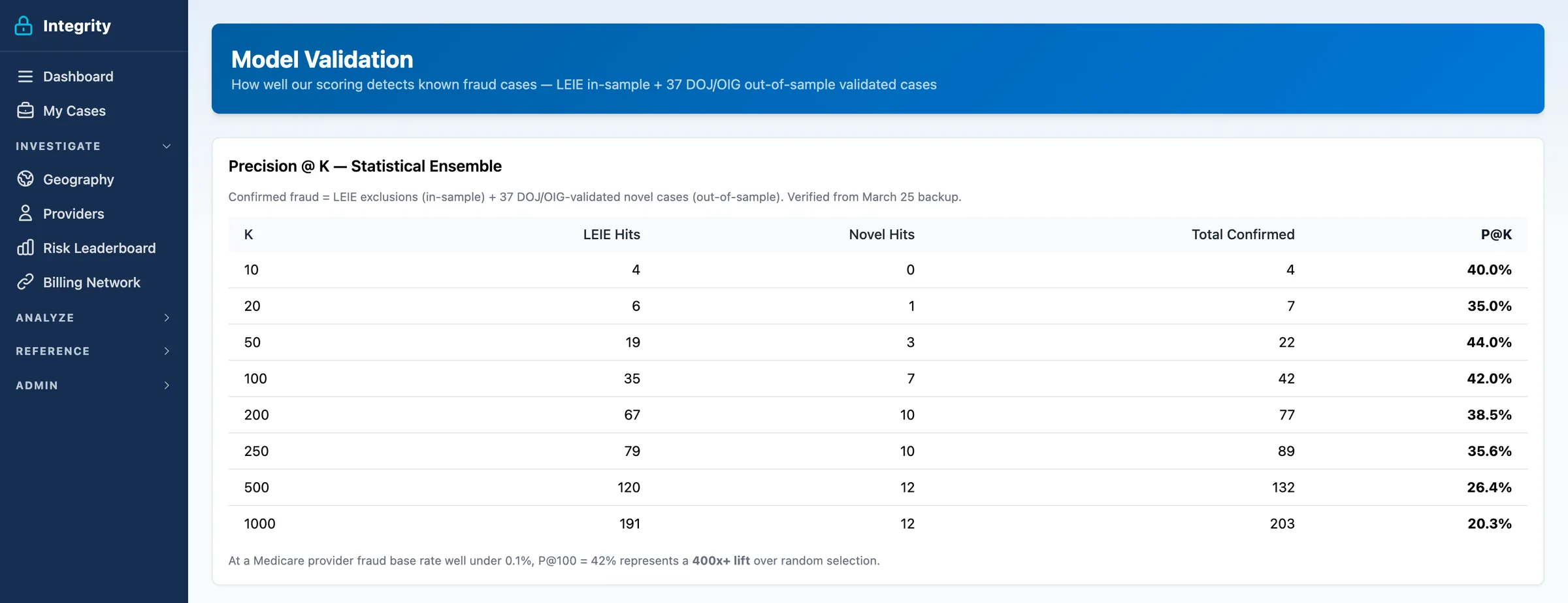
The hackathon build packages ingestion, scoring, and an interactive investigation dashboard in one Go binary. It combined 22 CMS datasets covering 10 years, scored 1.47 million providers, and built an analytical graph with 82.6 million edges from processed public records. Twenty-seven features across eight categories feed composite, machine-learning corroboration, and gradient-boosted-tree scoring methods.
A separate out-of-sample check matched 37 high-ranked non-LEIE providers to public enforcement cases involving over $500M in alleged or resolved fraud. These historical matches are not new agency fraud findings. The reported 6.9-year average lead before OIG exclusion is retrospective, not demonstrated prevention or realized savings. Read the full case study for methodology, backtest results, and out-of-sample validation details.
What you can inspect in the hackathon build
- Public data only: No protected health information (PHI), data use agreements, or claims-level access required
- Live weight adjustment: Investigators tune feature weights in real time and watch scores re-rank immediately
- Full transparency: Every score traces to source data, SQL queries, peer groups, and weights so investigators can inspect how it was produced
- Single binary: DuckDB, in-process GraphWizard, and all assets compile into one deployable system
- GraphWizard integration: 6 graph algorithms calculate features associated with shared relationships, prescribing isolation, and exclusion proximity
What Production Still Has to Prove
Before production work, we would agree on authorized public data, the investigative workflow, validation measures, explanations, access controls, accessibility, deployment, and operating responsibilities. The hackathon gives us a starting point. We would still need to test usefulness and controls with the people using and overseeing the system.
What we’re working on next
Pending work as of November 2026. Plans can change as we learn.
- Planned
Investigator case management
Sign-in, a case list, case detail and reports, so reviewers can record what they checked and why.
- Planned
Repeatable rankings
Break score ties consistently, so the same data always produces the same ranked list.
- Planned
Security and dependency review
Review sign-in, data export and third-party packages before any pilot.
- Planned
More public context data
Add neighborhood-level public data alongside the current CMS datasets.